The 74×109 (ex 74HC109) is a chip that contains two J-K flip-flops where the K input is inverted.
In this guide, you’ll learn the things you need to know about this chip in order to use J-K flip-flops with added functionality in your own projects.

What does the 74HC109 / 74LS109 do?
The 74×109 is a dual J-K flip-flop with clear and preset capabilities.
This means it contains two independent J-K flip-flops in one chip, each having inputs for J, K, clock (CP), and outputs (Q and Q̅). Additionally, it has clear (CLR) and preset (PRE) inputs for each flip-flop.
Note that the K input is inverted.
Here’s a simple explanation of what each input does:
- J and K Inputs: These control the state of the flip-flop. K is inverted, so it means that when J is HIGH and K is LOW, the flip-flop toggles its current state on the clock’s rising edge.
- Clock (CP): The flip-flop checks the J and K inputs and changes state based on them when the clock edge occurs.
- Clear (CLR): This input sets the Q output to LOW (0) immediately, regardless of other inputs.
- Preset (PRE): This input sets the Q output to HIGH (1) immediately, regardless of other inputs.
In the table below, you can see how to set, reset, and toggle the flip flop output.
| Clk | J | K | CLR | PRE | Q | Description |
|---|---|---|---|---|---|---|
| 0 | X | X | 1 | 1 | Q | Memory (no change) |
| 1 | 0 | 1 | 1 | 1 | Q | Memory (no change) |
| 1 | 1 | 1 | 1 | 1 | 1 | Set |
| 1 | 0 | 0 | 1 | 1 | 0 | Reset |
| 1 | 1 | 0 | 1 | 1 | Q̅ | Toggle |
| X | X | X | 0 | 1 | 0 | Async Reset |
| X | X | X | 1 | 0 | 1 | Async Set |
The 74×109 is useful for counting, storing data, and toggle switch applications in digital circuits. The clear and preset functions makes it particularly handy in situations where you need to be able to immediately set or reset the flip-flop state.
Build Something Useful This Evening
This gadget lets you use any IR remote-control to control your lamp, garden lights, heater oven, garage door, or anything else.
How To Use This Chip
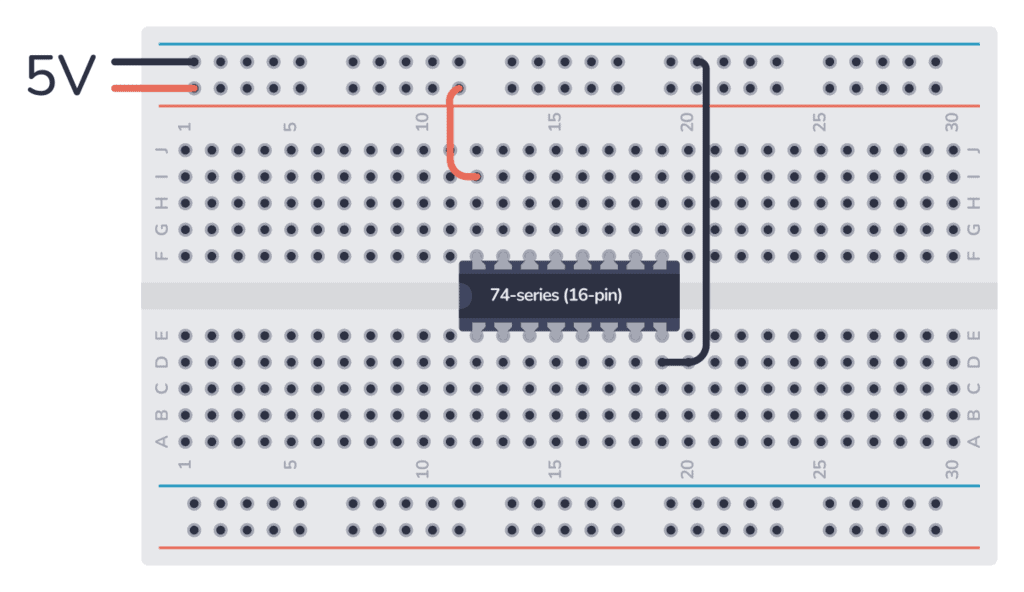
The 74HC109 comes in a 16-pin package, and you need to connect it to power before you can use it. Most 7400 ICs support a VCC voltage of 5V. One difference between the HC and LS version of the chip is that the 74HC109 supports 2V to 6V, while the 74LS109 only supports 5V.
74HC chips can normally supply a maximum of 4 mA from an output pin. If you’re using the 74LS version, the maximum current you can pull out of one output pin is 0.4 mA when the pin is high (sourcing) or 8 mA when the pin is low (sinking).
But these values can differ between models, so check the datasheet of your model to verify.
Once you’ve connected it to power, you can use the JK flip-flops inside.
74×109 Pinout
The 74×109 has 16 pins and contains two J-K flip-flops with set and reset laid out as shown in the pinout diagram below:

| Pin Name | Pin # | Type | Description |
|---|---|---|---|
| 1RST | 1 | Input | Reset input for the first JK flip-flop (active low). |
| 1J | 2 | Input | J input for the first JK flip-flop. |
| 1K | 3 | Input | K input (inverted) for the first JK flip-flop. |
| 1CLK | 4 | Input | Clock input for the first JK flip-flop. |
| 1SET | 5 | Input | Set input for the first JK flip-flop (active low). |
| 1Q | 6 | Output | Direct output from the first JK flip-flop. |
| 1Q | 7 | Output | Complementary output from the first JK flip-flop. |
| GND | 8 | Power | Connect to ground (GND). |
| 2Q | 9 | Output | Complementary output from the second JK flip-flop. |
| 2Q | 10 | Output | Direct output from the second JK flip-flop. |
| 2SET | 11 | Input | Set input for the second JK flip-flop (active low). |
| 2CLK | 12 | Input | Clock input for the second JK flip-flop. |
| 2K | 13 | Input | K input (inverted) for the second JK flip-flop. |
| 2J | 14 | Input | J input for the second JK flip-flop. |
| 2RST | 15 | Input | Reset input for the second JK flip-flop (active low). |
| VCC | 16 | Power | Positive power supply. Connect to +5V power. |
Alternatives and Equivalents for 74HC109 / 74LS109
There are many versions of the 74×109 chip. They all have the same functionality, but with different specifications such as supported voltages and maximum current output.
Here’s a list of a few equivalents of this chip:
- 74HC109 (High-speed CMOS)
- 74HCT109 (High-speed CMOS, TTL compatible)
- 74LS109 (High-speed TTL)
- 74LVC109 (Low Voltage TTL)
- 74AC109 (Advanced CMOS)
- 74ALS109 (Advanced Low-Power Schottky TTL)
- 74F109 (Very High Speed)
- 74C109 (CMOS, similar to the 4000-series)
Some manufacturers also add a prefix, such as the SN74HC109 and SN74LS109 by Texas Instruments.
Can’t find the 74×109 anywhere? Then try one of the following IC alternatives:
- 74×67 – AND-gated master-slave J-K flip-flop.
- 74×70 – AND-gated positive-edge triggered J-K flip-flop.
- 74×72 – AND-gated master-slave J-K flip-flop.
- 74×73 – Dual positive-edge triggered J-K flip-flop.
- 74×76 – Dual J-K flip-flop.
- 74×78 – Dual negative-edge triggered J-K flip-flop.
- 74×107 – Dual negative-edge triggered J-K flip-flop.
- 74×112 – Dual negative-edge-triggered J-K flip-flop.
- 74×113 – Dual negative-edge-triggered J-K flip-flop.
- 74×114 – Dual J-K flip-flop.
- CD4027 – Dual J-K master-slave flip-flop.
- CD4095 – Gated J-K flip-flop.
- CD4096 – Gated J-K flip-flop.
If you can’t find the 74×109 IC in your local electronics store, don’t worry, you’ll most likely find it in one of the stores listed on this page of online stores where you’ll find components and tools for all your electronics projects.
Datasheet for the 74LS109 and 74HC109 chips
Download the PDF datasheet for your version of the 74×109 here:
- SN74HC109 (Texas Instruments)
- 74HC109 (Nexperia)
- 74HC109 (Silicon Supplies)
- SN74LS109 (Texas Instruments)
- DM74LS109A (Fairchild)
10 Simple Steps to Learn Electronics
Electronics is easy when you know what to focus on and what to ignore. Learn what "the basics" really is and how to learn it fast.